Benks ArmorGo Qi2
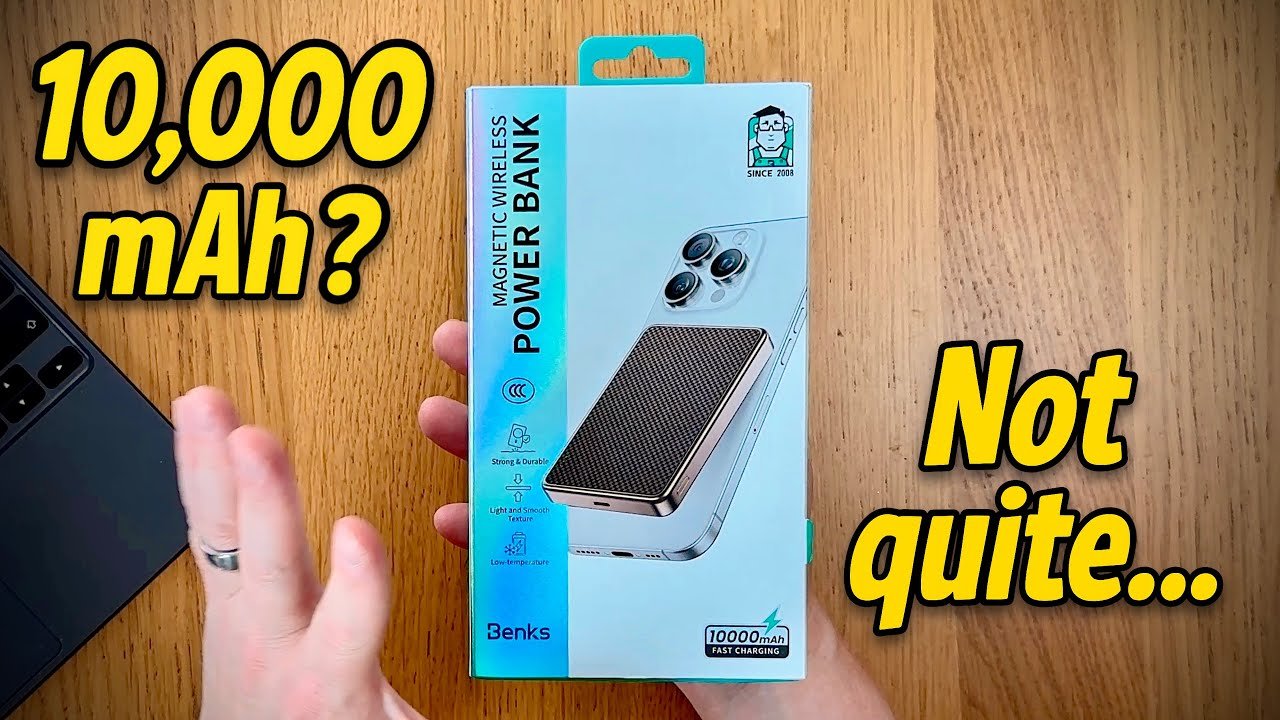
Portable power banks have become essential companions for modern smartphones. With devices like the iPhone 16 Pro Max pushing battery capacities past 4,500mAh, many of us expect a “10,000mAh” charger to refill our phone two or even three times. The marketing makes that sound plausible. The reality is more complicated.
The ArmorGo Qi2 Power Bank (10,000mAh) from Benks is one of the latest entrants in this space. Retailing at $59.99, it combines Qi2 wireless charging, MagSafe-style magnetic alignment, and a durable aramid fibre shell wrapped around a reinforced aluminium frame. The promise is clear: a stylish, reliable companion that can top up your phone wherever you go. But does it live up to that expectation?
Design and Build Quality
Straight out of the box, the ArmorGo feels premium. Benks has used aramid fibre, a material better known for its strength-to-weight ratio in aerospace and body armour. It is highly durable, resists scratches, and keeps the pack relatively lightweight for its size. The aluminium frame is not just for show: it doubles as a heat sink, helping the unit shed warmth during charging.
At 210 grams, the pack is not feather-light. When combined with a phone like the iPhone 16 Pro Max (216 grams), the total weight is close to half a kilogram. This means you will notice it in a pocket or bag. It is not unwieldy, but it is not one of the slim, “forget it’s there” packs either.
The magnetic alignment is excellent. N52-grade magnets—among the strongest permanent magnets commercially available—snap the pack securely to the phone’s back. There is no wobble or sliding, and it feels far more stable than early MagSafe-compatible banks.
Charging Standards and Performance
The ArmorGo supports the Qi2 wireless charging standard at up to 15W. Qi2 is an evolution of the Qi wireless protocol, designed to integrate with Apple’s MagSafe ecosystem while also broadening compatibility across other devices. A newer sub-version (Qi2.2) supports 25W wireless speeds, but this model does not support it.
One important caveat: you will only see the maximum 15W output when charging through a USB-C to USB-C connection. Relying purely on wireless means slower speeds and lower efficiency. This is not a flaw of the ArmorGo but a reality of current wireless charging technology.
Let’s talk about that for a moment …
Power bank capacities are quoted at the native voltage of the internal lithium-ion cells—typically 3.6–3.7V. A “10,000mAh” pack therefore contains around 37 watt-hours (Wh) of energy (10,000 × 3.7 / 1000).
Smartphones, however, do not charge at 3.7V. They typically charge at 5V, 9V, or even 20V using fast-charge protocols. To step up the voltage, the power bank’s circuitry must convert the energy, and that conversion is never perfect. Efficiencies of 80–90% are typical for wired charging. For wireless charging, efficiency drops further—to 60–70% in real-world conditions.
That means the usable output of the ArmorGo Qi2 is closer to 6,000–6,500mAh, and potentially less if relying only on wireless.
For a practical comparison:
iPhone 16 Pro Max battery ≈ 4,600mAh.
ArmorGo usable capacity (wired) ≈ 6,500mAh.
Result: roughly 1.3 full charges.
Over wireless: ≈ 1 charge, maybe slightly more.
This is not a failing of Benks. All power banks work this way. It is simply an area where marketing language and consumer expectations often drift apart.
Heat Management
Wireless charging generates heat as part of its inefficiency. The inductive coils inside both the phone and charger lose energy as heat, and many slim power banks become uncomfortably warm during extended sessions. Heat is not only a comfort issue but also a long-term battery health concern.
Benks claims that the ArmorGo’s aluminium frame dissipates heat more effectively, keeping surface temperatures relatively cool. In my—very limited—testing, this appears accurate: the unit warms up, but not to the point of discomfort. Over time, this should also help preserve the life of the internal cells, which degrade faster if frequently exposed to high temperatures.
Everyday Use
Practicality matters as much as numbers. Snapping the ArmorGo to the back of an iPhone is effortless, and the magnetic hold feels trustworthy. The size is manageable for use on the go, though the added bulk makes pocket carry less discreet. On a desk or in a bag, however, it is far less intrusive.
One oddity: Banks includes a USB-A to USB-C cable in the box. In 2025, this feels dated. A USB-C to USB-C cable would make more sense, especially since that’s the only way to achieve the maximum charging speeds.
Price and Value
At $59.99, the ArmorGo Qi2 sits in the middle of the market. It is not the cheapest option available, but the materials and build probably just about justify the price. Compared with budget banks that cut corners on heat management or magnet strength, the ArmorGo positions itself as a reliable daily tool rather than a disposable accessory.
Verdict
The ArmorGo Qi2 Power Bank is a well-engineered and practical wireless charging companion. Its strengths lie in build quality, secure MagSafe-style alignment, and cooler operation compared to rivals. Its weaknesses are the same as any wireless charger: inefficiency, slower speeds, and less capacity delivered than the headline suggests.
Consumers expecting two full iPhone charges will be disappointed. Those looking for a durable, Qi2-certified pack that pairs neatly with Apple’s MagSafe ecosystem will find the ArmorGo Qi2 a dependable choice.
In short: for convenience and design, it delivers. For raw efficiency, cables still win!
Affiliate link: benks.com Offer: 15% OFF site-wide on Benks Website (Use Code: Spark15)
*This video was originally uploaded to my YouTube channel on the 18th September 2025 - LINK
Please support my work and enable me to keep writing content like this by tapping here: BuyMeACoffee